
Ankle supports to secure the goalkeeper's supports
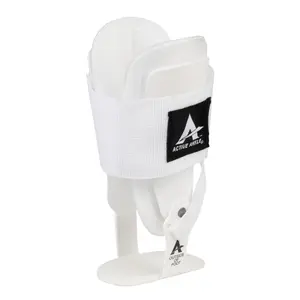


A goalkeeper's ankle brace stabilises the most stressed joint for the position: every lateral push, every catch after a tip and every throw goes through the ankle. From a simple neoprene sleeve to a brace with straps and splints, McDavid, Select, Thuasne, Epitact, PowerShot or Softee cover all levels of support.
Solid support for diving with confidence.
Why is the goalkeeper's ankle prone to sprains
The goalkeeper pushes off on one foot to relax, changes direction in a split second, and often lands on the side. These are exactly the moves that cause inversion sprains, when the foot rolls inward and stretches the outside ligaments of the ankle.
The ground increases the risk: a bumpy pitch twists the support, while a synthentic surface catches the stud instead of letting it slide. An ankle brace doesn’t eliminate this danger, but it limits the degree of roll while allowing the ankle to flex normally for jumping, pushing, and running.
Also protect shins, knees, and elbows
The ankle is just one area to cover: shin guards include models with built-in ankle protection, useful for young goalkeepers, knee pads cushion landings on the ground, and elbow pads protect during diving. All goalkeeper protections are gathered on the main page.
Neoprene, strapping, lacing, or braces: what level of support
- The neoprene sleeve, from Thuasne, PowerShot, Softee, or McDavid, provides warmth and light compression, ideal for prevention.
- Models with strapping straps, like the Novélastic from Thuasne or the ErgoStrap from Epitact, replicate the crossing of a sticky support without being disposable.
- The laced ankle guards from Select tighten like a shoe, down to the last centimetre.
- The braced orthoses from the Phantom range of McDavid slide on from the back, without laces, and combine stirrup braces with vertical straps to block lateral tilt.
Wearing an ankle brace with studs without losing feeling
A goalkeeper's ankle brace must fit into a football boot that’s often very snug. The Stealth Cleat from McDavid has been designed for this: low profile, back entry, thin compression strap at the top, and braces that follow the ligaments, all without adding bulk under the foot.
Always try your ankle brace with the sock and shoe you wear in a match. If the lacing presses on the top of your foot, loosen it a notch rather than taking off the orthosis. In terms of brands, Thuasne brings a rare medical culture: the French company was founded in 1847, is based in Levallois-Perret, and produces its orthoses and compression textiles in Saint-Étienne.
Good times to equip yourself with an ankle brace
Support ankle braces should be replaced when their straps loosen: Black Friday and the end-of-year holidays are good times, as well as the winter sales on the goalkeeper equipment promo page. In spring, the French Days for goalkeepers precede the summer sales and the resumption of training, and clearance items can be found on discount.
Frequently asked questions
Should you wear an ankle brace on both sides?
If only one ankle has been affected, generally an ankle brace on that side is enough. For prevention, some goalkeepers wear two to maintain the same feel on each take-off foot, especially since many models fit both left and right feet.
Is an ankle brace sufficient to return after a sprain?
It supports the return but doesn’t replace rehabilitation. The proprioception work prescribed by a physiotherapist remains essential, and it’s them or your doctor who determines the type of orthosis and duration of use.
Ankle brace or adhesive strapping applied by a physio: what to choose?
Adhesive strapping holds very firmly but is single-use and requires skill. The ankle brace can be put on alone in seconds, adjusted at half-time, and reused for months, making it more practical for everyday use.
How to wash a neoprene ankle brace?
By hand, in lukewarm water with a little mild soap, then flat drying away from a radiator or direct sunlight. Heat hardens neoprene and relaxes the elastics, which reduces support.
Should an ankle brace be worn over or under the sock?
Most are worn over a thin sock, or directly on the skin, then the match sock covers everything. An orthosis placed over the match sock may slip and rub against the shoe's shaft.